There’s a particular frustration that a lot of UK e-commerce founders know well. You launch, you try paid ads because that’s what everyone tells you to do, and you discover very quickly that competing with established players on Google Shopping or branded terms is either ruinously expensive or just… not winnable at your budget level. The incumbents can outspend you. They have brand recognition and review volume you don’t have yet. And the ad platforms are increasingly structured to extract maximum spend from businesses chasing short-term returns.
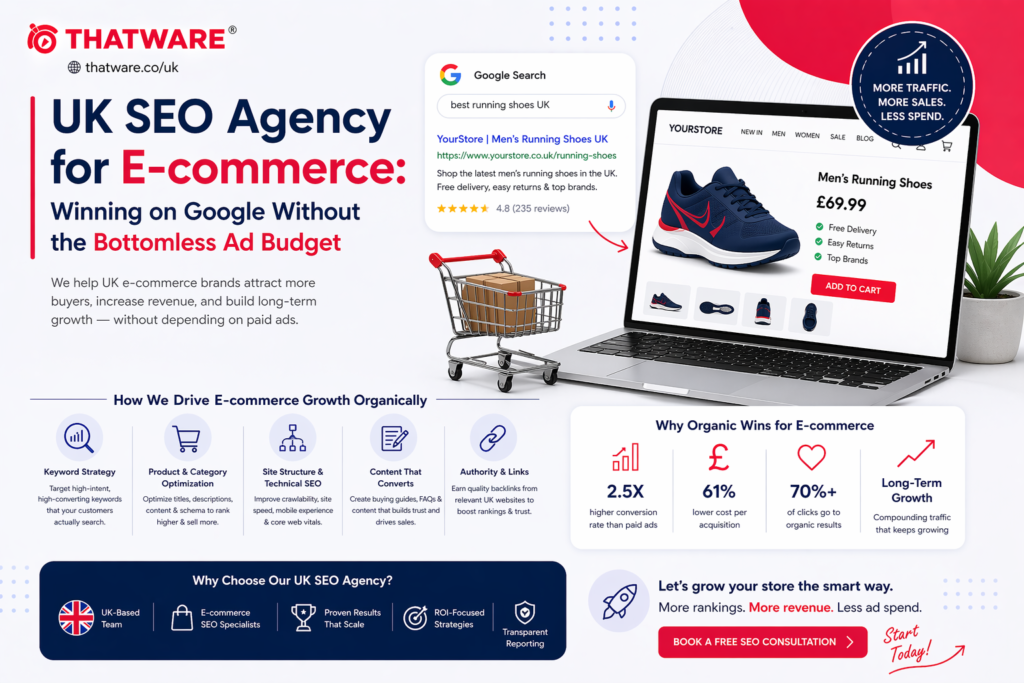
SEO is the counterintuitive answer to this – not because it’s cheap or fast, but because it’s the channel where genuine quality and smart strategy can genuinely outperform raw budget. A well-executed SEO strategy doesn’t care how much your competitor is spending on ads. And in UK e-commerce specifically, where there are real opportunities being consistently underexploited, organic search is still very much winnable for brands with the patience and the right approach.
Why UK E-commerce SEO Has Specific Nuances
UK consumers search differently from US consumers. Spelling conventions, product terminology, brand familiarity, even the way questions are phrased – these vary in ways that matter for organic search. “Trainers” versus “sneakers.” “Jumper” versus “sweater.” “Football” versus “soccer.” These aren’t trivial – they affect keyword targeting, content language, and whether your product pages feel genuinely relevant to the people searching for them.
More subtly, the UK competitive SEO landscape in most e-commerce categories is different from the US equivalent. There are fewer dominant players in many categories, and the ceiling for what strong organic performance looks like is often more achievable. The big-box US retailers that dominate American search results aren’t always the primary competition in UK category searches.
This means a well-positioned UK e-commerce brand can often build meaningful organic presence in competitive categories within 12-18 months with smart strategy and consistent execution – a timeline that would be optimistic in the US equivalent of the same category.
Category Pages Are Where Most UK E-commerce SEO Is Won or Lost
Most e-commerce SEO attention goes to product pages. Understandable – that’s where transactions happen. But in Google’s eyes, category pages are typically the most authoritative entry point for commercial category queries, and they’re where most of the high-volume, high-intent traffic lives.
A category page for “men’s waterproof jackets” or “handmade ceramic mugs” is competing for the queries that drive real volume. And most UK e-commerce category pages are embarrassingly thin – a grid of products and maybe a single paragraph of keyword-stuffed text that nobody reads.
Done well, category pages combine strong product organization with genuinely useful editorial content: buying guides, comparison frameworks, size and fit information, care instructions, relevant seasonal context. They answer the questions people have when they’re considering a purchase, not just when they’re ready to click buy. That approach consistently outperforms pure product grids in competitive category searches.
A good seo agency uk partner for e-commerce understands this and prioritizes category page strategy as foundational work – not an afterthought.
The Technical Foundation You Can’t Skip
E-commerce sites have specific technical SEO challenges that general SEO principles don’t fully address. Faceted navigation – the filtering systems that let users browse by size, color, price, brand – generates enormous numbers of duplicate or near-duplicate URLs if not handled correctly. A single product category with five filter types can generate thousands of URL variations, most of which should never be indexed.
Canonicalization and parameter handling for these systems is something a lot of e-commerce platforms handle poorly by default, and a lot of agencies don’t prioritize until rankings start mysteriously underperforming. Getting this right from the start – or fixing it early – is foundational.
Product pagination is a related issue. Deep pagination creates indexation problems and dilutes link equity if not structured properly. And product detail pages for out-of-stock or discontinued items need a deliberate strategy – not just 404s, which destroy any ranking equity those pages had built.
International variants are another layer for UK e-commerce brands operating across multiple European markets. Hreflang implementation at scale, currency and VAT handling, local payment method signals – these technical decisions have SEO implications that need to be built in, not retrofitted.
Content as a Long-Term Moat
The UK brands building the most durable organic search positions in e-commerce are using content to create a moat that competitors can’t easily replicate with budget alone.
That means publishing genuinely useful, specific editorial content in their category – buying guides, trend pieces, care and maintenance content, gift guides that are actually helpful rather than just SEO-written keyword lists. It means building topical authority in their category rather than just optimizing product pages for transaction keywords.
This content doesn’t need to be produced at enormous volume. A few high-quality, genuinely comprehensive pieces in the right topical areas outperforms dozens of thin, generic blog posts. And content that serves customers well – that gets bookmarked, shared, and referenced – builds the kind of natural link acquisition that paid link building can’t replicate.
Seo services uk that understand e-commerce content strategy position it as part of a long-term competitive moat, not just a traffic tactic. That perspective changes how resources get allocated and what success looks like.
Realistic Timelines and What to Expect
One of the most common points of friction between e-commerce brands and SEO agencies is expectations around timeline. Paid ads produce data and traffic in days. SEO produces meaningful results in months, and full competitive authority in a given category over years.
For a UK e-commerce brand starting from scratch in a competitive category, realistic expectations look something like this: technical foundation and on-page fundamentals in months one and two, early ranking movement on lower-competition long-tail terms by months three to four, meaningful traffic from mid-competition category terms by months six to nine, and competitive presence on high-volume category terms typically after twelve months of consistent effort.
Those timelines compress with budget (more content, more proactive link acquisition) and extend in more competitive categories. But they’re real timelines, and agencies that promise faster results in competitive categories are usually either misleading you or planning to cut corners in ways that create future problems.
The brands that commit to organic search seriously – and treat the 12-month investment with the same seriousness they’d give a paid channel – are consistently the ones who end up with the most durable competitive advantages online. Because most of their competitors don’t have the patience to do it right.